- CacheController
java
@RestController
@RequestMapping("/api/cache")
@CrossOrigin
public class CacheController {

    //final保证了不可变性
    private final LocalCacheManage cacheManage;

    //构造函数注入依赖
    public CacheController(LocalCacheManage cacheManage) {
        this.cacheManage = cacheManage;
    }

    /**
     * 业务接口:前端通过接口模拟并发抢购
     */
    @GetMapping("/get/{key}")
    public Map<String,Object> getData(@PathVariable("key") String key){
        long start=System.currentTimeMillis();
        String result= cacheManage.get(key,()->{  //先找缓存,如果没有,则执行loader.call
            TimeUnit.SECONDS.sleep(2);
            return "Real_Database"+key;
        });
        long end=System.currentTimeMillis();
        long duration=end-start;
        Map<String,Object> response=new HashMap<>();
        response.put("result",result);
        response.put("duration",duration);
        response.put("timestamp",System.currentTimeMillis());

        return response;
    }

    /**
     * 监控大屏接口:前端定时轮询获取最新命中率
     */
    @GetMapping("/stats")
    public Map<String, Object> getStats() {
        return cacheManage.getMetrics();
    }

    /**
     * 重置接口:一键清空重来
     */
    @PostMapping("/clear")
    public String clearCache() {
        cacheManage.clear();
        return "success";
    }
}- LocalCacheManage
java
/**
 * 核心并发组件:交由Spring容器单例管理
 */
@Component
public class LocalCacheManage {
    //底层高并发共享容器,保证多人操作不乱套,本地内存
    private final ConcurrentMap<String,String> cache=new ConcurrentHashMap<>();

    //核心监控指标
    private final AtomicInteger hitCount=new AtomicInteger(0);
    private final AtomicInteger missCount=new AtomicInteger(0);
    private final AtomicInteger blockedCount=new AtomicInteger(0);  //记录被限流保护挡在外面的请求

    //防击穿限流器:只允许一个线程查数据库
    private final Semaphore backOriginSemaphore=new Semaphore(1);

    /**
     * 核心获取方法
     */
    public String get(String key, Callable<String> loader) {
        String value = cache.get(key);
        if (value!= null) {
            hitCount.incrementAndGet();
            return value; // 极速命中
        }

        // 只有获取到信号量,才算真正的“回源(红色)”
        if (backOriginSemaphore.tryAcquire()) {
            try {
                value = cache.get(key);
                if (value != null) {
                    hitCount.incrementAndGet();
                    return value;
                }
                missCount.incrementAndGet(); // 真正穿透到数据库,记录 1 次红色
                System.out.println(Thread.currentThread().getName()+"执行耗时慢查询...");
                value = loader.call();
                if (value != null) cache.put(key, value);
                return value;
            } catch (Exception e) {
                return "异常";
            } finally {
                backOriginSemaphore.release();
            }
        } else {
            // 没抢到信号量,算作“拦截保护(灰色)”
            blockedCount.incrementAndGet();
            return "系统繁忙";
        }
    }

    /**
     * 暴露给前端的监控数据
     */
    public Map<String,Object> getMetrics(){
        Map<String,Object> stats=new HashMap<>();
        stats.put("hitCount",hitCount.get());
        stats.put("missCount",missCount.get());
        stats.put("blockedCount",blockedCount.get());

        int total=hitCount.get()+missCount.get();
        double hitRate = total==0?0:(double)hitCount.get()/total*100;  //点击率
        stats.put("hitRate", String.format("%.2f", hitRate)); // 保留两位小数
        return stats;
    }

    /**
     * 充值数据
     */
    public void clear(){
        cache.clear();
        hitCount.set(0);
        missCount.set(0);
        blockedCount.set(0);
    }
}
测试: 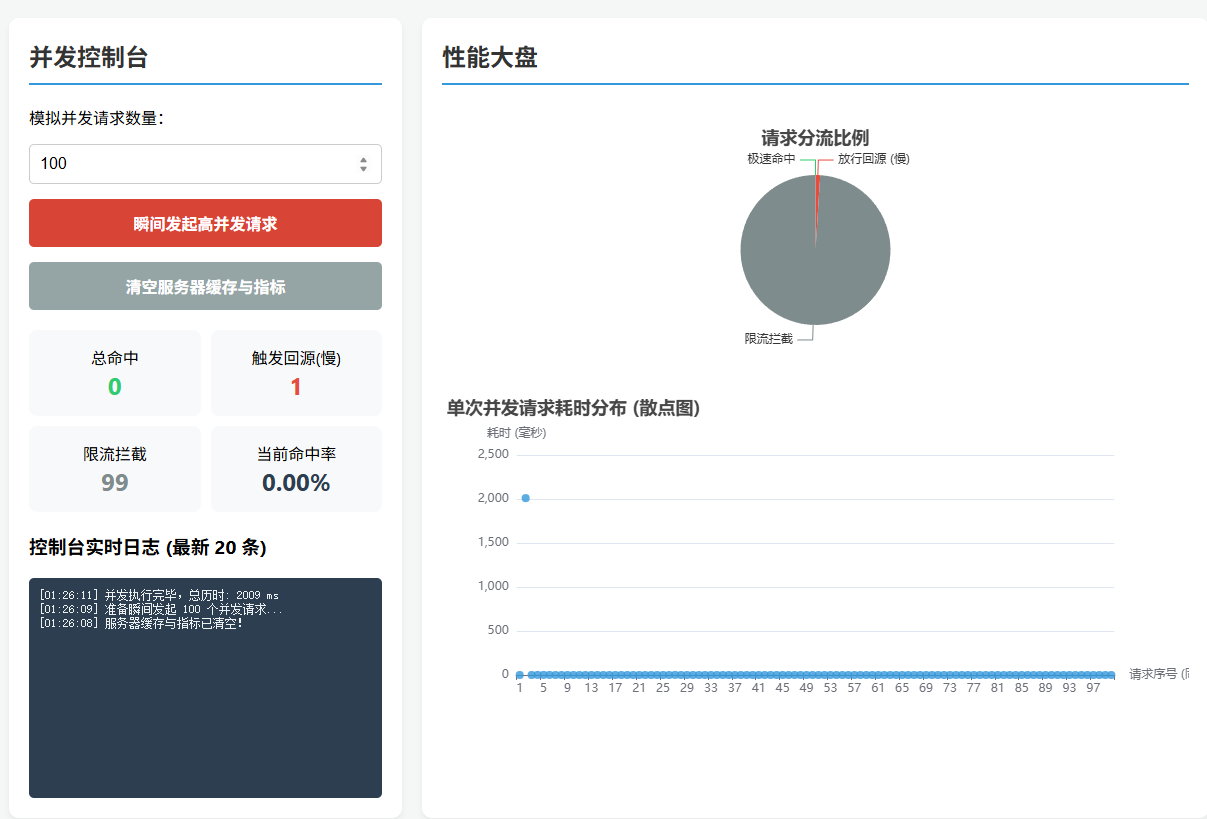
LocalCacheManage 是一个基于 JVM 本地内存构建的应用级高并发缓存组件。其在系统架构中的核心价值主要体现在:
- 响应性能: 提供微秒级的数据读取能力,消除网络 I/O 延迟。
- 高可用与容灾保障: 作为系统的“第一道防线”,在瞬时极高并发场景下,有效拦截绝大部分读请求,保护底层关系型数据库免受过载宕机风险。
- 缓存击穿防御:针对热点 Key 失效的瞬间,通过并发控制机制,保证回源操作的串行化或限流,彻底解决缓存击穿问题。